


How to Improve IELTS Writing From a Low Starting Level

Many IELTS candidates begin Writing at a low or uneven level. They may struggle with grammar accuracy, repeat the same vocabulary, feel unsure how to structure answers, or simply not understand what examiners are looking for.
This is normal. IELTS Writing is not about talent or “natural English”. It is a controlled skill that improves when you build the right foundations in the right order.
This guide is designed for learners starting around Band 4.0–5.5 and shows how to move toward Band 6.0–7.0 without memorising essays or using language you can’t control.
What “Low Level” Usually Means in IELTS Writing
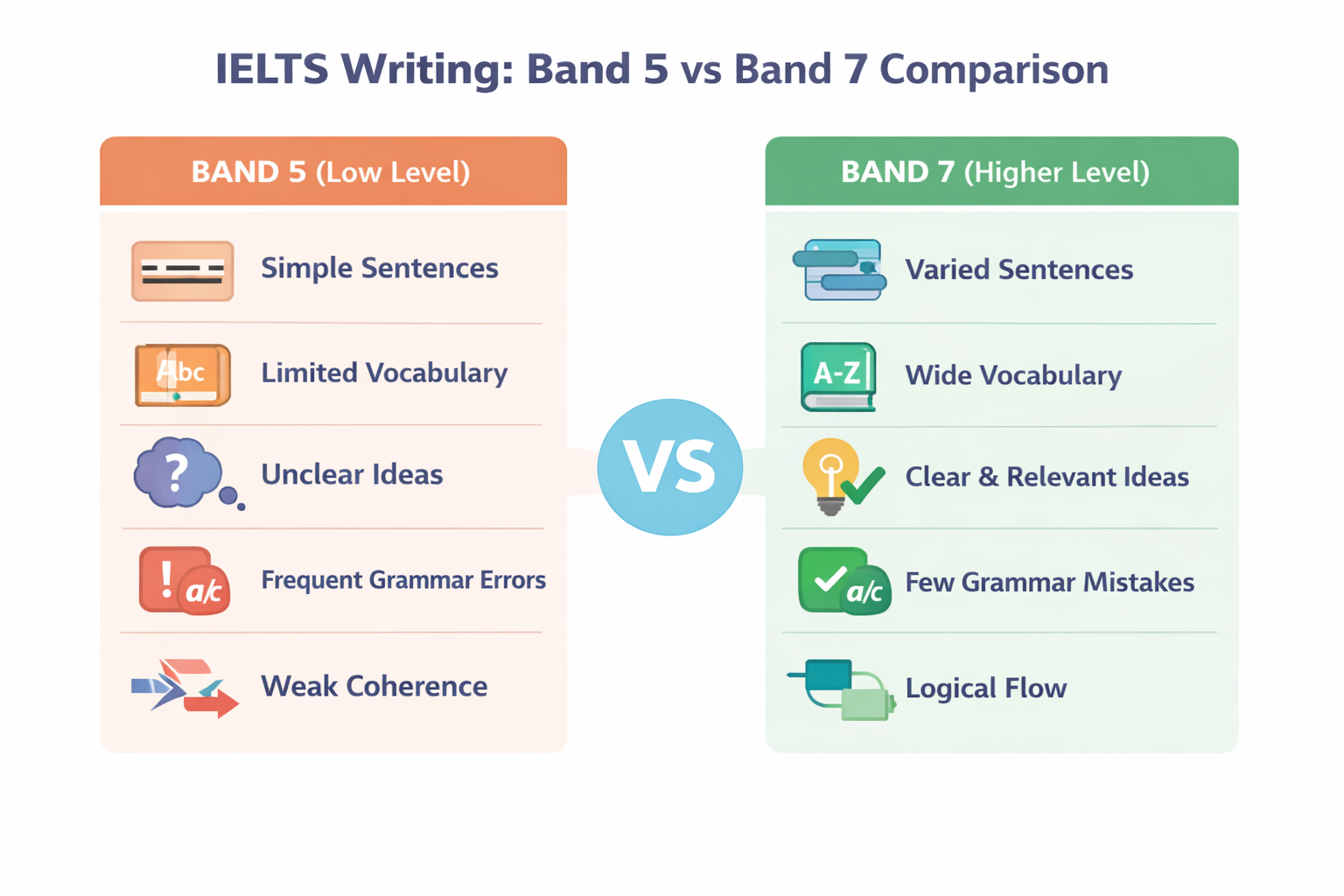
A low starting level does not mean poor intelligence or weak ideas. It usually means the core writing skills are underdeveloped.
Common signs include:
- Limited sentence structures
- Weak paraphrasing
- Poor coherence and linking
- Frequent grammar mistakes
- Ideas that are unclear or repetitive
Different learners struggle in different ways, but the solution is almost always the same: build skills layer by layer, not all at once.
The Biggest Mistake Low-Level Learners Make
Many learners try to improve too fast by:
- Memorising full essays
- Forcing “Band 9 vocabulary”
- Copying complex sentence structures
This usually leads to:
- More grammar errors
- Lower coherence
- Reduced Task Achievement
IELTS Writing rewards clarity and control, not complexity. Simple language used accurately scores higher than advanced language used incorrectly.
Step 1: Gain Control of Sentences Before Writing Full Essays
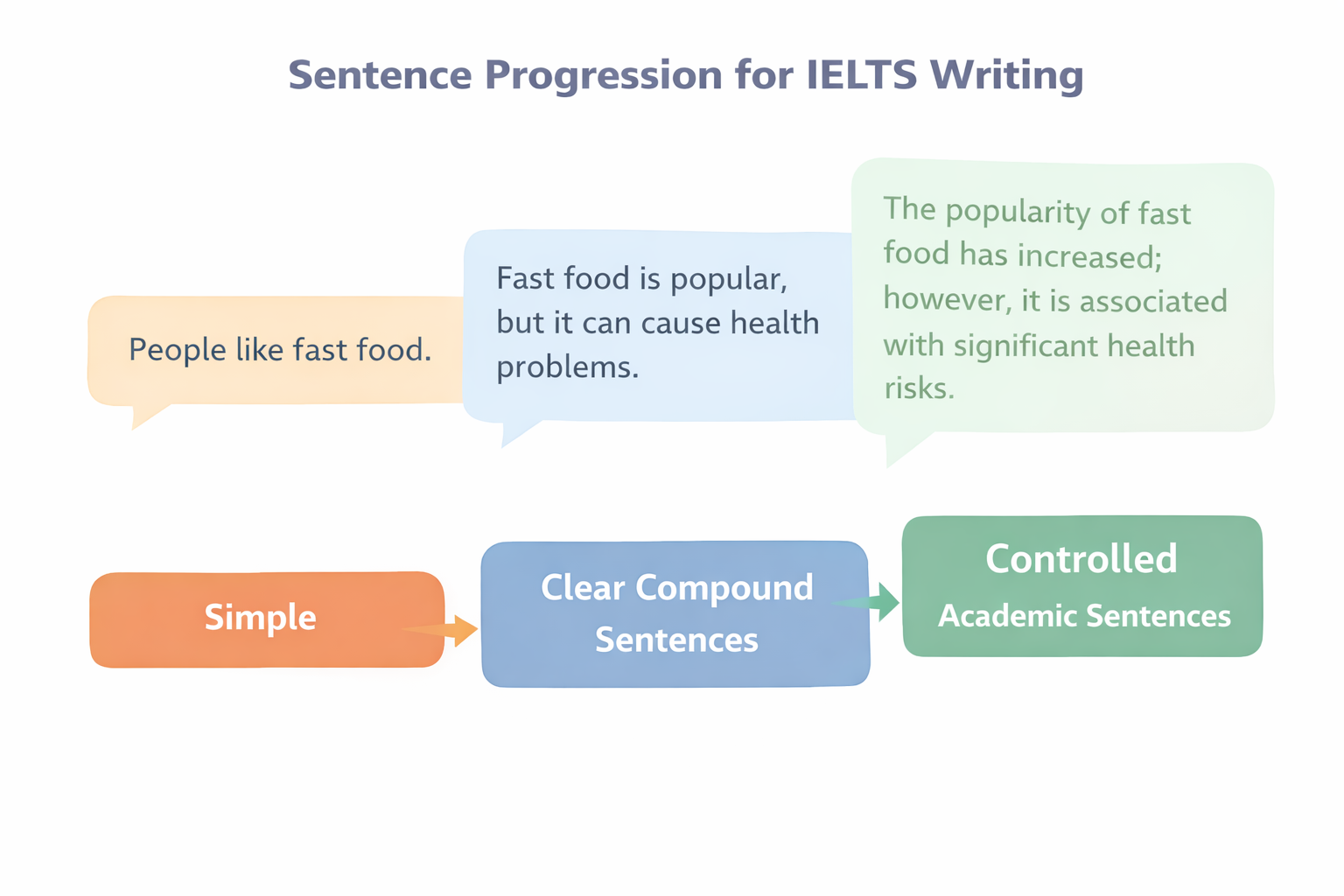
Before focusing on introductions, conclusions, or full essays, learners must control basic sentence construction.
This means:
- Writing clear, grammatically correct sentences
- Using common academic sentence patterns
- Avoiding long or risky structures at the beginning
Examples of useful base patterns include:
- One major reason for this is that…
- This issue has become increasingly important in recent years.
- As a result, many people believe that…
At a low level, accuracy matters more than variety. Strong sentence control makes every later skill easier.
Step 2: Treat Paraphrasing as a Core Skill, Not a Trick
Paraphrasing is essential in both Task 1 and Task 2, but many low-level learners misunderstand it.
Common problems include:
- Changing only one word
- Using incorrect synonyms
- Breaking grammar while paraphrasing
Effective paraphrasing practice focuses on:
- Changing word forms
- Using more general vocabulary
- Restructuring the sentence safely
Example:
Many people believe that children should learn at home.
→ It is widely believed that home education is more suitable for children.
Paraphrasing improves through repetition and pattern awareness, not memorisation.
Step 3: Improve Coherence Using Discourse Markers and Sequencing
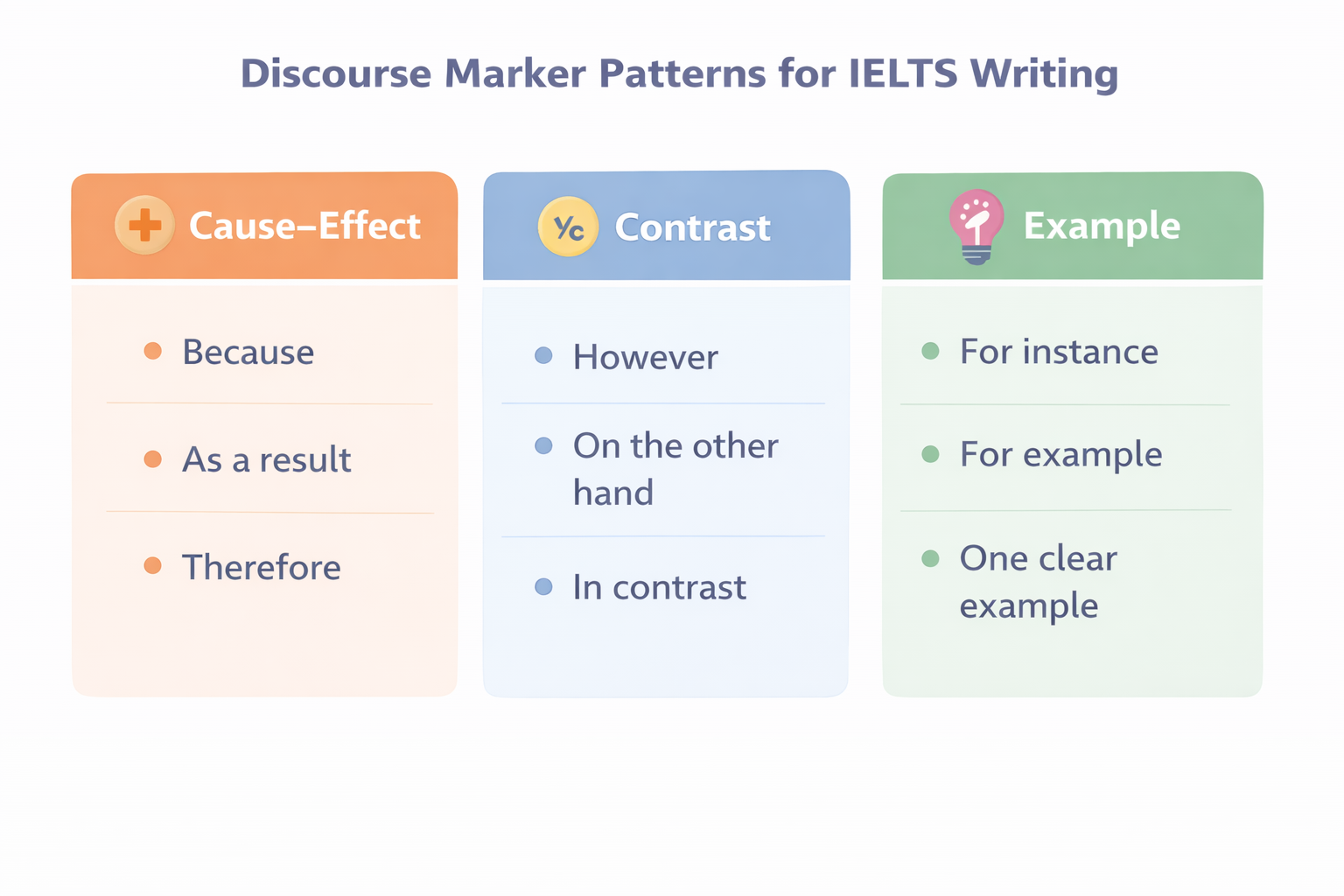
Many low-band essays lose marks because ideas are not clearly connected. This is a coherence issue, not an ideas issue.
Typical problems include:
- Ideas listed without explanation
- Sudden topic changes
- Overuse or misuse of linking words
Instead of memorising long lists of connectors, learners should practise logical sequencing, such as:
- Cause and effect
- Contrast
- Addition
- Examples
Clear progression of ideas matters more than advanced vocabulary.
Step 4: Use Model Answers Actively, Not Passively
Simply reading Band 8 or Band 9 essays does very little for beginners.
More effective practice involves:
- Identifying the question type
- Understanding the writer’s position
- Analysing how paragraphs are structured
- Observing how ideas are developed
For Task 2 especially, working backwards from a model answer helps learners understand how examiners expect responses to be built.
This trains exam awareness, not copying.
Step 5: Practise Task 1 and Task 2 as Separate Skills
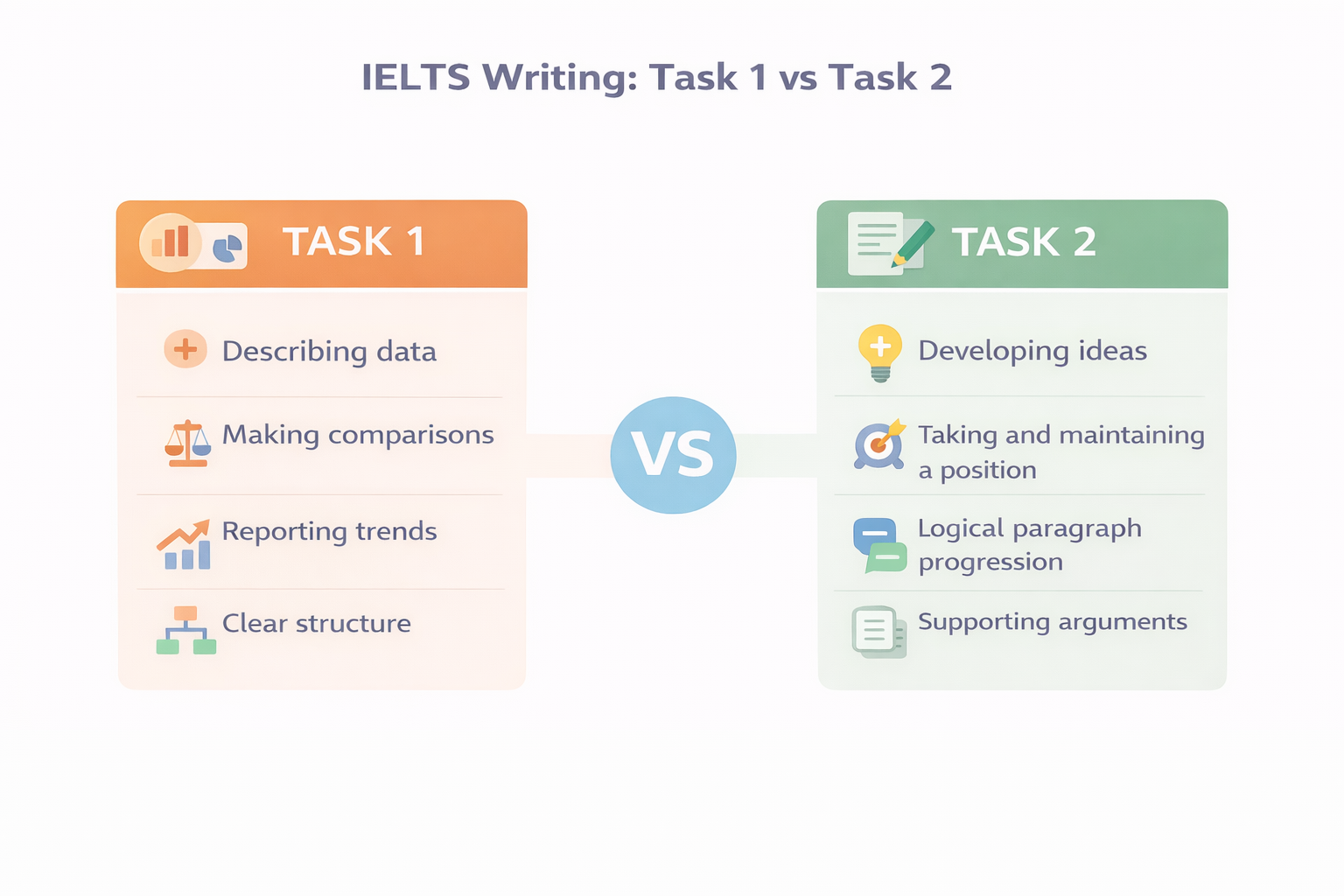
Task 1 and Task 2 require different abilities and should not be practised in the same way.
Task 1 focuses on:
- Describing data
- Making comparisons
- Reporting trends
- Clear structure
Task 2 focuses on:
- Developing ideas
- Taking and maintaining a position
- Logical paragraph progression
- Supporting arguments
Low-level learners often progress faster when they practise:
- Language patterns for Task 1
- Paragraph construction for Task 2 before full essays
Step 6: Practise Writing Regularly, But With Constraints
Writing full essays every day is inefficient at a low level.
More effective practice includes:
- Short writing tasks
- One skill focus at a time
- Rewriting and improving the same content
Occasional full essays are useful, but most improvement comes from focused skill practice, not constant test simulation.
Realistic Improvement Goals From a Low Starting Level
With consistent, targeted practice, progress often looks like this:
Speed varies, but improvement is predictable when fundamentals are trained correctly.
Final Thoughts: Build the Core First
Strong IELTS Writing is built on:
- Controlled sentence structures
- Reliable paraphrasing
- Clear sequencing of ideas
- Grammar accuracy
- Purposeful vocabulary
Starting from a low level is not a disadvantage. It allows learners to build correct habits from the beginning instead of fixing mistakes later.